Introduction
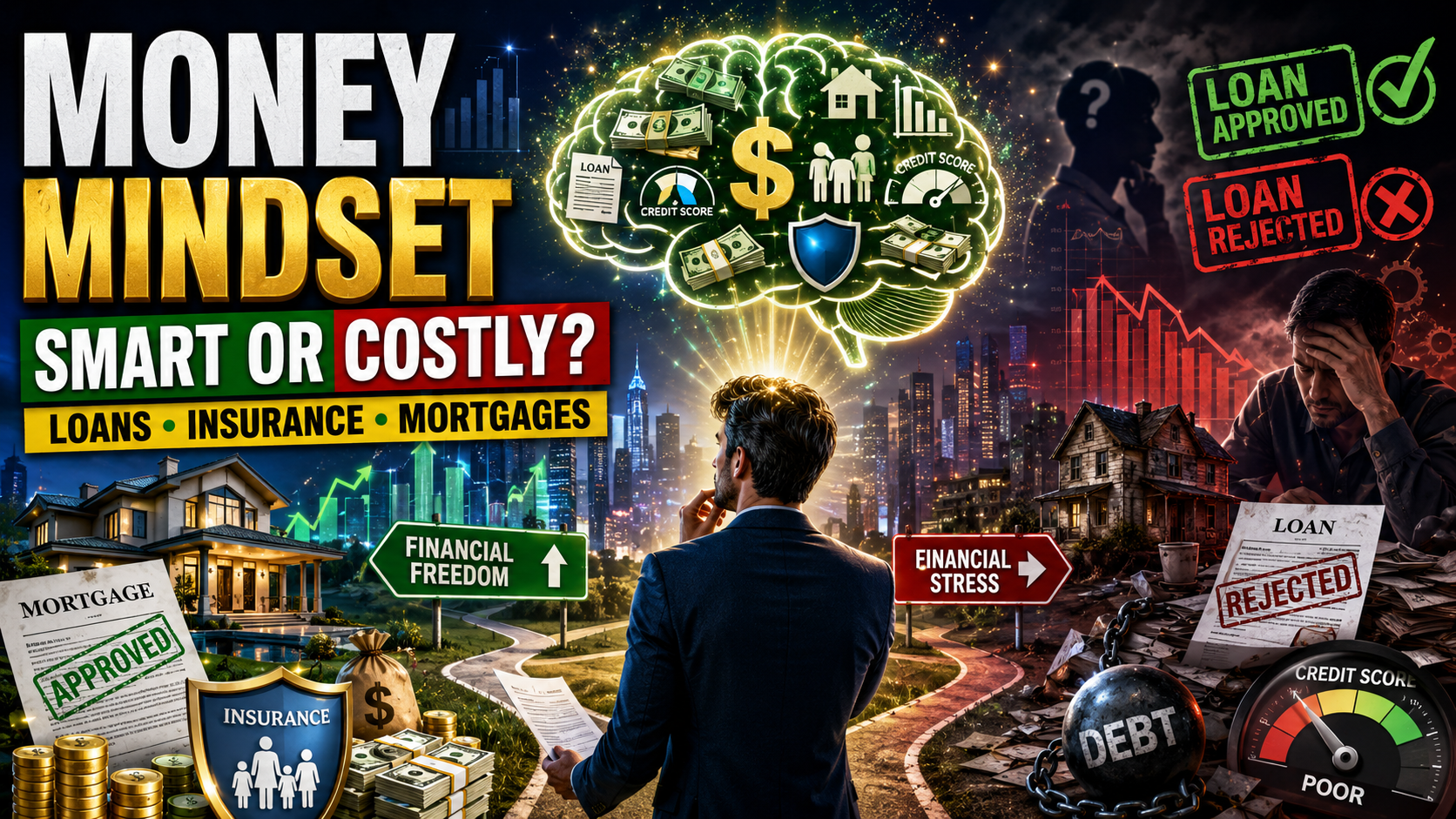
Why do two people with the same income, same credit score, and same financial options end up in completely different situations? One owns a home, has term life insurance, and sleeps peacefully at night. The other rents, avoids insurance, and lies awake worrying about debt.
The difference isn’t math. It’s psychology.
Money decisions are emotional first and rational second. This article explores the hidden psychological forces that shape how you handle loans, insurance, and mortgages — and how to rewire your brain for better financial outcomes.
Part 1: The Fear of Debt – When Healthy Caution Becomes Paralyzing
Debt is a tool. But for millions of people, the word “loan” triggers the same brain regions as “snake” or “spider.” This fear keeps them safe from predatory loans — but also prevents them from taking good debt that builds wealth.
The Two Types of Debt Anxiety
Type 1: Productive Fear – You avoid payday loans, title loans, and credit card cash advances. This fear saves you thousands.
Type 2: Paralyzing Fear – You refuse to take a mortgage even when rent is higher than a mortgage payment. You pay cash for cars even when 0% financing is available. You avoid student loans for degrees that would double your income.
The Cost of Paralyzing Debt Fear
| Scenario | Fear-Based Decision | Smart Decision | Lifetime Cost of Fear |
|---|---|---|---|
| Buying a home | Rent for 10 extra years to save 20% down | Buy with 5% down, pay PMI temporarily | $50,000+ lost equity |
| Buying a car | Pay $15,000 cash for a used car | Finance at 3% and invest the $15,000 | $10,000+ lost investment returns |
| Education | Skip college due to loan fear | Take federal student loans, increase income | $500,000+ lower lifetime earnings |
How to Overcome Debt Fear
The 5% Rule for Borrowing: Ask yourself, “If this loan helps me achieve a goal that is 5%+ better than my current situation, is it worth the discomfort?” Usually, the answer is yes.
Start small. Take a $1,000 personal loan from a credit union. Repay it in 6 months. Prove to your brain that debt is manageable.
Part 2: The Insurance Gambler – “Nothing Will Happen to Me”
At the opposite end of the spectrum is the person who skips insurance because “bad things happen to other people.” This is called optimism bias — your brain’s tendency to believe you are less likely than average to experience negative events.
The Math of Optimism Bias
Let’s say you skip health insurance to save 300/month(3,600/year).
The odds of a hospitalization in any given year for a healthy 30-year-old are about 5-10%. But the average hospital stay costs 15,000–50,000.
Expected value calculation:
- Cost of insurance: $3,600 (certain loss)
- Expected cost of no insurance: 15,000×101,500
Wait — 1,500islessthan3,600! Does that mean skipping insurance is rational?
No, because of two factors:
- Catastrophic risk – A $200,000 cancer treatment would be a 2,000% loss.
- Your brain cannot handle low-probability, high-impact events. We are wired to underestimate them.
The Solution: Buy Insurance, Then Forget About It
The healthiest psychological approach is to treat insurance like a utility bill. You don’t expect to “get value” from your fire insurance every month. You pay it because the alternative is unthinkable.
Action step: Set all insurance premiums to auto-pay. Check them once per year. Otherwise, don’t think about them.
Part 3: The Endowment Effect – Why You Overvalue Your Home
The endowment effect is a psychological bias where you value something more simply because you own it. This is deadly when making mortgage and home-selling decisions.
How the Endowment Effect Hurts Homeowners
You bought your house for 300,000fiveyearsago.Today,asimilarhousedownthestreetsoldfor350,000. Your house needs a new roof ($15,000) and has outdated kitchen.
A rational valuation: 350,000–15,000 – 20,000(kitchen)=315,000.
But because you own the house, you think: “My house is special. The new kitchen can wait. I want $360,000.”
Result: Your house sits on the market for 8 months. You refuse reasonable offers. Eventually, you sell for $325,000 — less than if you had priced it correctly from day one.
The Solution: Pretend You Don’t Own It
Before making any mortgage or home sale decision, ask: “If I did not own this house today, would I buy it at this price?”
If the answer is no, sell. If the answer is yes, keep it. This simple question removes the endowment effect.
Part 4: Loss Aversion – The Reason You Won’t Refinance
Loss aversion is a Nobel Prize-winning concept from psychologists Daniel Kahneman and Amos Tversky. It states: Losing 100hurtstwiceasmuchasgaining100hurtstwiceasmuchasgaining100 feels good.
This bias explains why people don’t refinance their mortgages even when it saves them money.
The Refinance Math vs. The Refinance Emotion
The math: Refinancing saves you 200/month.Closingcostsare4,000. Break-even is 20 months. You plan to stay for 10 years. Total savings: $20,000.
The emotion: You focus on the 4,000closingcost(acertainlossnow)ratherthanthe20,000 savings (a future gain). Your loss-averse brain says: “What if I move in 18 months? I’ll lose money!”
The reality: Even if you move in 18 months, the refinance cost is a rounding error compared to home sale proceeds.
How to Beat Loss Aversion
Calculate the worst-case scenario. If rates drop 1% and you refinance, the absolute worst case is you move in 12 months and lose 1,000–2,000 on closing costs. That is a small price for the chance to save $20,000.
Action step: When refinancing, ask yourself: “Would I pay 2,000fora9020,000?” Most people would say yes. That’s exactly what refinancing offers.
Part 5: Hyperbolic Discounting – Why You Choose Payday Loans
Hyperbolic discounting is our tendency to choose smaller, immediate rewards over larger, delayed rewards — even when the delayed reward is massively better.
This is why payday loans exist. You need 500todayforacarrepair.Apaydayloancosts600 to repay in two weeks (400% APR equivalent). A credit card would cost 510(20505 (10% APR).
But the payday loan is the fastest. Your brain says: “I need money NOW. Future me will worry about repayment.”
The Neuroscience of Bad Borrowing
When you are stressed about money, your brain’s prefrontal cortex (responsible for long-term planning) goes offline. Your amygdala (fear center) takes over. You make impulsive, short-term decisions.
The Solution: Create Friction for Bad Loans, Remove Friction for Good Loans
- Create friction: Delete payday loan apps from your phone. Unsubscribe from their emails. Make it hard to borrow badly.
- Remove friction: Set up a line of credit with your credit union BEFORE you need it. Keep a $1,000 emergency fund in a separate savings account.
The goal: When an emergency happens, your default option should be a good option (savings or low-interest credit), not a bad option (payday loan).
Part 6: Anchoring – How Lenders Manipulate Your Loan Decisions
Anchoring is our tendency to rely too heavily on the first piece of information we receive. Lenders use this against you constantly.
Examples of Anchoring in Finance
Mortgage anchoring: The lender shows you a 30-year payment of 2,000/month.Thentheyoffera15−yearmortgageat2,800/month. The 15-year loan looks expensive — even though it saves you $150,000 in interest.
Car loan anchoring: The dealer says, “What monthly payment can you afford?” You say 500.Theystretchtheloanto84monthstohitthatpayment.Youpay42,000 total for a $30,000 car.
Credit card anchoring: The bank says, “You’re approved for 15,000!”Youthink“wow!”andspendmorethanyouplanned.Theanchor(15,000) makes $5,000 seem small.
How to Break the Anchor
Always calculate the total cost, not the monthly payment. A 500/monthpaymentfor36months(18,000 total) is better than 400/monthfor60months(24,000 total) — even though the monthly payment is higher.
Bring your own anchor. Before any loan conversation, decide: “I will not pay more than 8% interest” or “I will not take a loan longer than 48 months.” State your anchor first.
Part 7: Mental Accounting – The Reason You Keep Bad Insurance
Mental accounting is treating money differently depending on its source or intended use. This leads to irrational insurance and mortgage decisions.
Examples of Mental Accounting Gone Wrong
**You pay 200/monthforwholelifeinsurance∗∗because“it′saninvestment“whilecarrying10,000 in credit card debt at 22% interest. The credit card debt is costing you 2,200/yearininterest.Thewholelifepolicyisearningyou248/year). You are losing $2,152/year because you mentally separate “insurance money” from “debt money.”
**You keep 50,000inasavingsaccountearning12,000) because you mentally label the savings as “emergency fund” and the mortgage as “different.”
The Solution: One Big Mental Bucket
All your money is one big pool. Every dollar has one job: to maximize your net worth.
Decision rule: If you have debt above 5% interest, pay it down before investing in low-return assets (savings accounts, CDs, whole life insurance). If you have debt below 4%, invest instead.
Part 8: Practical Exercises to Rewire Your Money Brain
Exercise 1: The 10-Year Lookback
Write down three financial decisions you regret. For each one, identify the emotion driving it (fear, greed, anchoring, loss aversion). Then write: “Next time I feel [emotion], I will [action].”
Example: “Next time I feel fear about mortgage debt, I will calculate the rent vs. buy comparison using the 5% rule.”
Exercise 2: The Reverse Budget
Most budgets start with income and subtract expenses. That’s scarcity thinking. Instead, start with goals.
Write: “In 10 years, I want [specific financial goal].” Then work backward: “To achieve that, I need to save Xpermonth.Therefore,IcanspendY per month on everything else.”
Exercise 3: The Insurance Audit
List every insurance policy you have. Next to each, write: “I keep this because [reason].” If the reason is “just in case” — that’s valid. If the reason is “my agent said so” or “I’ve always had it” — investigate further.
Conclusion: Your Brain Is the Problem and the Solution
The best loan terms in the world won’t help if fear stops you from taking them. The best insurance policy is useless if optimism bias convinces you to skip it. The most favorable mortgage rate doesn’t matter if anchoring tricks you into a 30-year loan when a 15-year loan is affordable.
Financial success is 20% math and 80% psychology.
- Know your biases: loss aversion, anchoring, optimism bias, mental accounting.
- Build systems: auto-pay, separate savings accounts, decision rules.
- When emotions run high, wait 24 hours before signing anything.
- Run the numbers. Then run them again. Then trust the math, not the feeling.
Your financial future is not determined by the economy, the stock market, or interest rates. It is determined by the six inches between your ears.